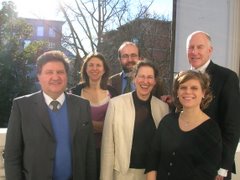
International Conference
Communication and Cognition 2011: Manipulation, Persuasion and Deception in Language
January 26-28 2011 - University of Neuchâtel, Switzerland
Read more on the CONFERENCE WEBSITE
The overall aim of this conference is to explore the various parameters that affect the way we process communicated information; as a case in point, this 2011 edition will focus on the issue of persuasive, manipulative, biased and fallacious verbal communication, with the goal of shedding light on different parameters that play a role in its 'success'. In this respect, we seek contributions which specifically focus on those (formal, informal, cognitive, linguistic and contextual) aspects of communication that orient the interpretation of language and fulfil argumentative and persuasive ends, be it in interpersonal or mass communication.
In the past, discursive manipulation and neighbouring phenomena such as lies, deception, persuasion and uncooperative communication, to name a few, have been investigated by a variety of researchers in numerous fields in the humanities and the social sciences. Among those are philosophy (e.g. Chisholm & Feehan 1977, Mahon 2007, Parret 1978); persuasion research (e.g. Petty & Cacioppo 1986, Chaiken 1987); linguistics, in particular pragmatics (e.g. Attardo 1997, Tanaka 1994, Blass 2005, Saussure 2005); cognitive linguistics (e.g. Chilton 2004); communication science (e.g. McCornack 1992, O'Keefe 2002); (critical) discourse analysis (e.g. Galasinski 2000, van Dijk 2006, Wodak 2007); argumentation theory (e.g. van Eemeren & Grootendorst 2004, Jacobs 1995), not to mention the classical tradition of rhetoric. However, the link between persuasive or deceptive communication and the cognitive underpinnings allowing for its success, already explored by trends in persuasion research, still needs to be fully drawn and understood, given that the available literature on the topic leaves too often aside the communicative dimension of manipulation and seldom aims for a psychologically plausible account of such communication-dependent phenomena.
Recent developments in cognitive science call for new research questions in the field of deceptive persuasion and manipulation through verbal communication, in particular in what regards the cognitive grounds of misguided and credulous interpretation - and more generally of gullibility (see Maillat & Oswald 2009). Emotions, trust, confidence and other attitudes have long been considered as keys for the effectiveness of persuasive language; the connotative load of certain keywords and more generally the role of the lexicon, as well as types of syntactic structures and other linguistic devices such as presuppositions have also been suspected to bear on the persuasive force of deceptive communication. However, little is known yet as to why and how these processes, including fallacious argumentation as a whole, jeopardize evaluation. Recent research in this growing field tends to confirm the hypothesis that communicative phenomena linked to deception and persuasion exploit cognitive biases and heuristics otherwise useful for the general economy of human communication. A long established concern for these cognitive biases and heuristics in information processing (see Wason 1966, 1968, Kahneman & Tversky 1974), which can in turn yield cognitive illusions and errors in information processing (see Pohl 2004), together with the input of cognitive anthropology (e.g. Mercier & Sperber, forth. Sperber et al. forth.) and developmental psychology (Mascaro & Sperber 2009, Clément 2010, Harris et al. forth.) opens a new promising trend of research on the persuasiveness of deceptive communication.
It is one of the purposes of this conference to stimulate interdisciplinary inquiry on these themes. Accordingly, contributions promoting an integration of different - yet complementary - trends into interdisciplinary models of information processing are encouraged. The organisers will particularly welcome papers located at the interface of the disciplines concerned, whether grounded on empirical evidence or presenting a theoretical model.
Saturday, 7 August 2010

Monday, 26 July 2010
The Fourth TOKYO CONFERENCE ON ARGUMENTATION: The Role of Argumentation in Society
A very early announcement, by the way... I am always a bit reluctant about making commitments about the future. Who knows? I have no idea where I will be.
But still, an interesting conference that deserves to be published on my blog: "The role of argumentation in Society".
Besides, imagine going to Japan! I love sushi :-)
The Fourth TOKYO CONFERENCE ON ARGUMENTATION: The Role of Argumentation in Society
August 10-12, 2012
Sponsored by the Japan Debate Association (JDA)
------------------------------------Keynote Speakers------------------------------------
David Zarefsky, PhD Yoshiro Yano, PhD
Northwestern University Chuo University
CALL FOR PAPERS
The 4th Tokyo Conference on Argumentation will be held August 10-12, 2012, in Tokyo, Japan. The conference is sponsored by the Japan Debate Association (JDA). The conference is designed to encourage exchanges of views on the theory, practice and instruction of argumentation across the disciplines. Presentations related to the convention theme “The Role of Argumentation in Society” are encouraged, but proposals are not restricted to it. Potential topics of interest include: argumentation and rhetoric, forensic pedagogy, the philosophy and psychology of reasoning, practical studies, and studies of historical argumentative texts. Qualified papers will appear in our Proceedings to be distributed at the Conference.
On-line submission of abstracts will be accepted starting November 16, 2010. Submit your title, affiliation and abstract (200-300 words) by January 15, 2012, on our web site at: http://japan-debate-assoociation.org/tokyo_conference/ Acceptance will be notified by February 20, 2012. Accepted authors who wish to have their papers considered for publication in the Proceedings must submit full manuscript by May 20, 2012. If you have questions, please contact Planning Committee Chair Takeshi Suzuki, School of Information and Communication, Meiji University, 1-9-1 Eifuku, Suginami, Tokyo 168-8555 JAPAN, or send your question at: http://japan-debate-organization.org/form/question.html
But still, an interesting conference that deserves to be published on my blog: "The role of argumentation in Society".
Besides, imagine going to Japan! I love sushi :-)
The Fourth TOKYO CONFERENCE ON ARGUMENTATION: The Role of Argumentation in Society
August 10-12, 2012
Sponsored by the Japan Debate Association (JDA)
------------------------------------Keynote Speakers------------------------------------
David Zarefsky, PhD Yoshiro Yano, PhD
Northwestern University Chuo University
CALL FOR PAPERS
The 4th Tokyo Conference on Argumentation will be held August 10-12, 2012, in Tokyo, Japan. The conference is sponsored by the Japan Debate Association (JDA). The conference is designed to encourage exchanges of views on the theory, practice and instruction of argumentation across the disciplines. Presentations related to the convention theme “The Role of Argumentation in Society” are encouraged, but proposals are not restricted to it. Potential topics of interest include: argumentation and rhetoric, forensic pedagogy, the philosophy and psychology of reasoning, practical studies, and studies of historical argumentative texts. Qualified papers will appear in our Proceedings to be distributed at the Conference.
On-line submission of abstracts will be accepted starting November 16, 2010. Submit your title, affiliation and abstract (200-300 words) by January 15, 2012, on our web site at: http://japan-debate-assoociation.org/tokyo_conference/ Acceptance will be notified by February 20, 2012. Accepted authors who wish to have their papers considered for publication in the Proceedings must submit full manuscript by May 20, 2012. If you have questions, please contact Planning Committee Chair Takeshi Suzuki, School of Information and Communication, Meiji University, 1-9-1 Eifuku, Suginami, Tokyo 168-8555 JAPAN, or send your question at: http://japan-debate-organization.org/form/question.html
Wednesday, 14 July 2010
ISSA conference 2010
I haven't been writing for a while but this was an important month for argumentation scholars. From June 29 to July 2 we have been experiencing the 7 ISSA conference in Amsterdam.
An impressive number of scholars has participated in this event, which was a really good occasion for scientific dialogue. For me personally, the ISSA conference this year has opened new interesting research paths. It has also allowed me to see different traditions of the study of argumentation, "encountering", for example, many interesting studies coming from rhetoricians working in the US.
We were a numerous group of Swiss researchers, including many PhD students working on argumentation in context - which is one of the results of the doctoral program Argupolis (www.argupolis.net).
The detailed conference program had been published here: http://cf.hum.uva.nl/issa/ISSA%20detailed%20programme%202010.pdf. The ISSA Conference proceedings are in the process of being prepared.
An impressive number of scholars has participated in this event, which was a really good occasion for scientific dialogue. For me personally, the ISSA conference this year has opened new interesting research paths. It has also allowed me to see different traditions of the study of argumentation, "encountering", for example, many interesting studies coming from rhetoricians working in the US.
We were a numerous group of Swiss researchers, including many PhD students working on argumentation in context - which is one of the results of the doctoral program Argupolis (www.argupolis.net).
The detailed conference program had been published here: http://cf.hum.uva.nl/issa/ISSA%20detailed%20programme%202010.pdf. The ISSA Conference proceedings are in the process of being prepared.
Wednesday, 9 June 2010
On dialogue, argumentation and reasoning in small children
Don’t tell me children are not able to reason and argue…
A small selection
Son: about 2 years and a half old. Mother and father: two academics of undefined age (“don’t ask to a lady how old she is!”, how they put it in Italy; I will apply the same rule to my husband, in this case)
Socratic dialogue
« Mammi », why is papa at work ?
‘Cause he needs to earn money to buy things.
For example, mozzarella?
Yes, that’s important. Papa works to buy mozzarella.
And why does he stay in the office all day long? I mean, do you need a lot of money just to buy some mozzarella??
...embarrassed silence.
Babies’ education
Little sister is eating some solid food in which “mammi” had put some Grana cheese. Little sister seems not to appreciate it and tends to spit it out
“Why are you spitting it out? (standpoint) It’s Grana cheese! (argument based on the universally acknowledged endoxon: Grana cheese is tasty”
On definition
“Mammi”, are you going to the mums’ playground, the university?
Family relations.
Husband: “wife, I am going”.
He goes.
Son (to his mother): “wife, you know, your mother is my grandmother”.
On heaven.
Son: Why has he gone to heaven?
Mum: you know, everybody goes to heaven at a certain point. Everyone of us.
Son: I see. But I need to know why.
On wooden ceilings
You know, “mammi”, this ceiling once was a tree.
Who told you?
The grandfather did. Then they cut the tree and made the ceiling.
Right.
And what was our house doing when there was a tree on the top of it instead of a ceiling?
On cannons.
I have a cannon “mammi”, now I will shoot you!
The battle starts.
Are you ok?
No, I am not. I am full of holes now.
And are you feeling well?
Not quite. I think I am dead.
Can you cook while you are dead?
No, I suppose I can’t. People do not do things while they are dead, unfortunately.
Let me help you…
Recent metaphors and similes (produced this week).
(1) < “Mammi” goes to pick him up at the nursery. She waits out of the door, which is a decorated opaque glass>.
You know “mammi”, I have seen you out of the door. You looked like a BIG OMELETTE
(???)
(2) Young boy drinks water from a bottle that had stayed for some time out of the fridge. It is a very hot day. The water is warm
“mammi”: Oh sorry, it is warm, let me change it!
Noooooooo, I like it, IT IS LIKE HAVING THE SUN IN MY GLASS
A small selection
Son: about 2 years and a half old. Mother and father: two academics of undefined age (“don’t ask to a lady how old she is!”, how they put it in Italy; I will apply the same rule to my husband, in this case)
Socratic dialogue
« Mammi », why is papa at work ?
‘Cause he needs to earn money to buy things.
For example, mozzarella?
Yes, that’s important. Papa works to buy mozzarella.
And why does he stay in the office all day long? I mean, do you need a lot of money just to buy some mozzarella??
...embarrassed silence.
Babies’ education
“Why are you spitting it out? (standpoint) It’s Grana cheese! (argument based on the universally acknowledged endoxon: Grana cheese is tasty”
On definition
“Mammi”, are you going to the mums’ playground, the university?
Family relations.
Husband: “wife, I am going”.
He goes.
On heaven.
Son: Why has he gone to heaven?
Mum: you know, everybody goes to heaven at a certain point. Everyone of us.
Son: I see. But I need to know why.
On wooden ceilings
Who told you?
The grandfather did. Then they cut the tree and made the ceiling.
Right.
And what was our house doing when there was a tree on the top of it instead of a ceiling?
On cannons.
I have a cannon “mammi”, now I will shoot you!
The battle starts.
Are you ok?
No, I am not. I am full of holes now.
And are you feeling well?
Not quite. I think I am dead.
Can you cook while you are dead?
No, I suppose I can’t. People do not do things while they are dead, unfortunately.
Let me help you…
Recent metaphors and similes (produced this week).
(1) < “Mammi” goes to pick him up at the nursery. She waits out of the door, which is a decorated opaque glass>.
You know “mammi”, I have seen you out of the door. You looked like a BIG OMELETTE
(???)
(2) Young boy drinks water from a bottle that had stayed for some time out of the fridge. It is a very hot day. The water is warm
“mammi”: Oh sorry, it is warm, let me change it!
Noooooooo, I like it, IT IS LIKE HAVING THE SUN IN MY GLASS
Tuesday, 8 June 2010
A new site (Tim van Gelder) on argument mapping
Following a workshop on argument mapping for university-level educators, Tim van Gelder has opened a new website (ARGUMENT MAPPING IN YOUR SUBJECT): http://sites.google.com/site/argumentmappinginyoursubject/
I quote from his description:
"Rather than creating a standard paper handout, I created a small website, Argument Mapping in Your Subject. [..] The website is a kind of portal to resources which might be helpful for educators seeking to better understand argument mapping and how to integrate into the subject they teach, whatever that may be. Mostly the website just links to resources already available elsewhere, but does provide some useful original content including, in particular, some case studies of how educators have incorporated argument mapping into their subjects, one in Economics, and another in Computer Science."
I quote from his description:
"Rather than creating a standard paper handout, I created a small website, Argument Mapping in Your Subject. [..] The website is a kind of portal to resources which might be helpful for educators seeking to better understand argument mapping and how to integrate into the subject they teach, whatever that may be. Mostly the website just links to resources already available elsewhere, but does provide some useful original content including, in particular, some case studies of how educators have incorporated argument mapping into their subjects, one in Economics, and another in Computer Science."
Subscribe to:
Posts (Atom)