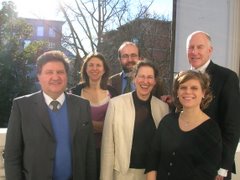
Faculty of Communication sciences, Lugano
Gentili Signore,Egregi Signori,Abbiamo il piacere di annunciare che:
venerdì 27 marzo 2009 alle ore 10.30 in aula A 24
Sara Greco Morasso
difenderà la sua tesi di dottorato dal titolo:
Argumentative and other communicative strategies of the mediation practice.
La giuria sarà composta da:Prof. Eddo Rigotti, Usi (direttore di tesi); Prof. Frans van Eemeren, Università di Amsterdam (membro esterno); Prof. Dr. Anne-Nelly Perret-Clermont, Università di Neuchâtel (membro esterno); Presiede la difesa il Prof. Ivan Snehota.
The success mediation is experiencing in several societal domains (Sander 1979; Moffitt and Bordone 2005) is mainly bound to the possibility that this practice offers to find a win-win solution that truly meets the parties’ interests (Princen 1992a; Menkel-Meadow 2005). This possibility is exclusively supported by communicative instruments and, specifically, by means of argumentation. In mediation, in fact, the parties are competent and responsible for the decision on the conflict, while the mediator not only intervenes as a third neutral, but he/she is also not held and not authorized to advance proper standpoints or arguments in favour of a specific outcome (van Eemeren et al. 1993): what he/she is in charge of doing is to stimulate parties to discuss reasonably, to motivate them to find a solution of the conflict, and to keep trace of their zones of agreement. Indeed, what the mediator properly does is helping the parties’ assumption of an argumentative attitude; in fact, in successful mediation, two conflicting individuals, entrenched in an escalating spiral of hostility, become co-arguers, able to tackle their differences of opinion by means of reasonable discussion.A relevant question becomes, thus, understanding how mediators can help and foster such a radical change in the parties’ attitude and how this actually contributes to the happy fulfilment of the mediation goal, namely to the resolution of the conflict.In order to answer this question, the present dissertation has been organized along two main research focuses.First, a comprehensive ontological framework of mediation conceived of as an interaction scheme (Rigotti and Rocci 2006) has been reconstructed. This framework allows considering all relevant factors and their relations in the context of the mediation script from its origin, namely some form of conflict (Yarn 1999), to its short-term and long-term outcomes. Its elicitation has required a conceptual analysis of mediation based on a reasoned interdisciplinary synthesis of different scientific approaches (see among others Wall, Stark and Standifer 2001; Herrman, Hollett and Gale 2006).Second, using this framework as a term of comparison, an argumentative analysis of mediation has been proposed, based on empirical evidence of a corpus of successful cases. The analysis shows how mediation encompasses a macro-text of argumentative discussions that allows the fulfilment of the pragmatic goal of conflict resolution. The mediator’s argumentative activity emerges, in particular, in relation to a wise management of the topical potential (van Eemeren and Houtlosser 2002). Mediators have a determinant influence in setting up the parties’ discussion, in particular in relation to the creation of an “argumentative space” based on a sound confrontation stage and to the analysis of the parties’ conflict and of the relationships it jeopardizes (in the opening stage). As the discussion proceeds, parties progressively manage it themselves, by assuming an argumentative attitude.A key to explain the parties’ change is constituted by the consideration of their interests. Some moves allowing to evoke interests, like presupposition accommodation (Greco 2003; Cigada 2008), have emerged in the analysis. In this way, the present research explains how, through argumentative means, mediators manage to focus on interests rather than on the parties’ claimed positions (Fisher, Ury and Patton 1991), not rarely discovering that these interests are not incompatible but even mutually inclusive.These outcomes represent actual advances in the theoretical understanding of mediation and in the investigation of the role played in this practice by argumentative processes. They also provide a basis to design aware conflict resolution interventions.