Friday, 11 May 2007
USILINK: "L'argomentazione unisce Amsterdam e Lugano"
An article about research on argumentation at the University of Lugano (Institute for linguistics and semiotics) has been published on the new issue of the newsletter USILINK. See http://www.press.unisi.ch/usilink (the article is in Italian).

Wednesday, 9 May 2007
Douglas Walton at the University of Lugano

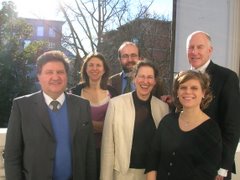
During the last two weeks of April, Douglas Walton from the University of Winnipeg was visiting professor at the University of Lugano. He hold different conferences and research seminars, and gave a PhD course on Types and Properties of Dialogues.
The scientific discussions involved members of the Institute for linguistic and semiotics (Eddo Rigotti, Jakob Wüest, Andrea Rocci, Sabrina Mazzali, Sabine Christopher-Guerra, Agatha Filimon, Radouan Jelassi, Rudi Palmieri, Camilla Palmieri, Joelle Stoudmann and myself) but also colleagues from other institutes: Martin Eppler, Paolo Paolini, Lorenzo Cantoni, Peter Schulz, Stefano Tardini, Davide Bolchini, Sara Rubinelli... Francesco Arcidiacono (University of Neuchâtel) also joined the discussions.
The scientific discussions involved members of the Institute for linguistic and semiotics (Eddo Rigotti, Jakob Wüest, Andrea Rocci, Sabrina Mazzali, Sabine Christopher-Guerra, Agatha Filimon, Radouan Jelassi, Rudi Palmieri, Camilla Palmieri, Joelle Stoudmann and myself) but also colleagues from other institutes: Martin Eppler, Paolo Paolini, Lorenzo Cantoni, Peter Schulz, Stefano Tardini, Davide Bolchini, Sara Rubinelli... Francesco Arcidiacono (University of Neuchâtel) also joined the discussions.
Among the discussion topics, I would mention the notion of commitment in dialogue, the classification of argument schemes, the application of argumentation to different contexts (D. Walton is conducting research on legal argumentation at the moment, whereas the Institute for linguistics and semiotics in Lugano presented in particular the research and teaching activities on financial argumentation), argument visualization tools...
During this period, Chris Reed from the University of Dundee, and Fabrizio Macagno from the Catholic University of Milan, who work together with D. Walton, also participated in the discussions. Chris Reed also gave a presentation during the PhD course for introducing the software Araucaria (http://araucaria.computing.dundee.ac.uk/), which was much appreciated by the participants.

Monday, 26 March 2007
Polisemy: a warning by Aristotle
"It is useful to have examined the number of meanings of a term both for clearness’ sake (for a man is more likely to know what it is he asserts, if it has been made clear to him how many meanings it may have), and also with a view to ensuring that our reasonings shall be in accordance with the actual facts and not addressed merely to the term used. For as long as it is not clear in how many senses a term is used, it is possible that the answerer and the questioner are not directing their minds upon the same thing: whereas when once it has been made clear how many meanings there are, and also upon which of them the former directs his mind when he makes his assertion, the questioner would then look ridiculous if he failed to address his argument to this". Topics, Book I, translated by Pickard-Cambridge, W.A. 2004, eBooks@Adelaide
Friday, 23 February 2007
Boris A. Uspenskij at USI
Boris A. Uspenskij will be at USI on March 12, 2007 (from 10:30 to 12:30, room 351) for a conference organized by the Istituto linguistico-semiotico http://www.ils.com.unisi.ch/ on the topic:
Law and Religion in Muscovite Russia
Law and Religion in Muscovite Russia
Abstract:
"The author of the present paper tries to explain why there was no witch-hunt in Russia at the time when it was a common phenomenon in Western Europe. It is argued that witches had a special social and legal position in Russia. Their position can be understood in view of specific relations between Church and state in the country".
"The author of the present paper tries to explain why there was no witch-hunt in Russia at the time when it was a common phenomenon in Western Europe. It is argued that witches had a special social and legal position in Russia. Their position can be understood in view of specific relations between Church and state in the country".
B. Uspenskij's biography (in Italian):
Studioso assai noto nella comunità scientifica internazionale per aver affrontato con molta originalità svariate discipline nell´ambito linguistico-semiotico, culturologico e storico. Dopo le ricerche agli inizi degli anni ´60 nel campo morfologico e tipologico, ha esteso la sua ricerca alla filologia (in particolare slava), alla storia della lingua, alle arti figurative, per giungere alla semiotica della storia e alla semiotica della cultura. Ha sviluppato la sua ricerca e la sua carriera di docente all´Università di Mosca, insegnando però come visiting professor anche alle università di Vienna, Harvard e Graz. Ha collaborato a lungo alla Scuola di Tartu con Jurij Lotman. Nel 1993 è stato chiamato dall´Istituto Universitario Orientale di Napoli. È autore di numerosissime pubblicazioni, tradotte fra l´altro in tutte le maggiori lingue occidentali, e membro di numerose associazioni e accademie di prestigio internazionale.
Friday, 16 February 2007
Interesting link
Today I suggest an interesting link to another blog: http://www.pierrepilon.com/ (in French), where Mr. Pillon has collected his note on a small conference he organized in January about: "Les représentations graphiques et visuelles de la preuve et des inférences dans un contexte juridique".
Douglas Walton and Tim van Gelder were among the participants.
Douglas Walton and Tim van Gelder were among the participants.
Subscribe to:
Posts (Atom)